
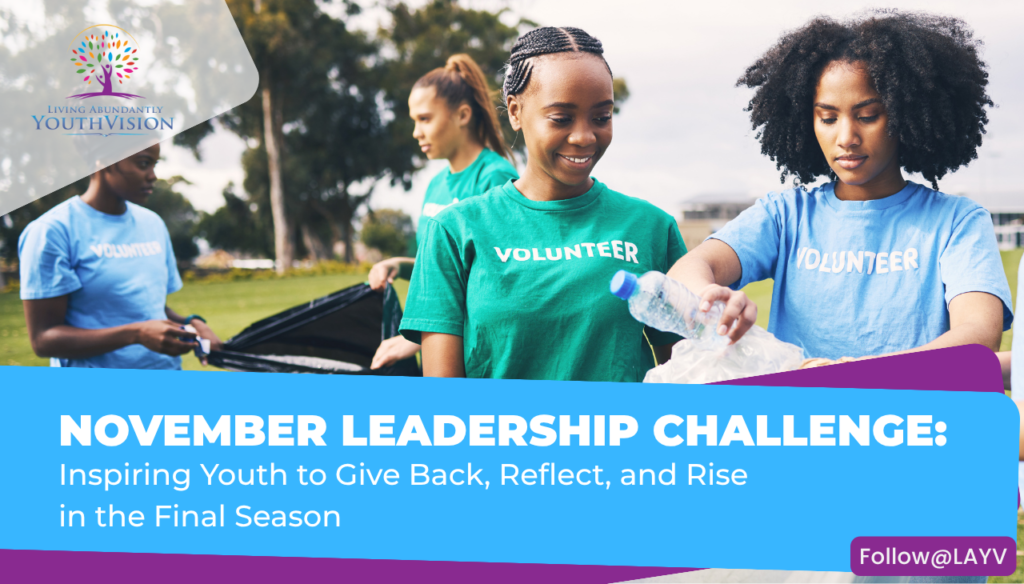
November invites gratitude, but gratitude should eventually move.
After recognizing the people, lessons, opportunities, and progress that have shaped us, an important question follows: What will we do with what we have received?
For young people, that question creates a bridge between personal development and leadership. Youth leadership through service teaches that influence is not primarily about being noticed. It is about noticing what needs attention – and developing the courage, discipline, and compassion to respond.
At Living Abundantly Youth Vision (LAYV), leadership development is connected to character, responsibility, communication, decision-making, and community contribution. Young people do not have to wait until adulthood to make an impact. They can begin where they are, with what they know, using what they have.
Explore LAYV’s youth-development programs: LAYV Programs
Leadership Becomes Visible Through Service
Leadership is easy to admire when it comes with a microphone, title, award, platform, or recognition. Service reveals a different side of leadership.
Can you contribute when nobody is applauding? Can you notice someone else’s needs? Can you follow through on a responsibility? Can you work with people who think differently from you? Can you help solve a problem instead of simply complaining about it? These are leadership questions.
LAYV has previously emphasized that leadership begins with responsibility and can show up through helping classmates, organizing projects, volunteering, mentoring younger students, communicating well, and solving problems.
“Leadership is not proven by how many people notice you. It is proven by what becomes better because you showed up.” |
Service gives young people a practical environment for developing leadership because real people and real needs require more than theory.
Youth Leadership Through Service Develops Character
Service is not only valuable because somebody receives help. The person serving can change too.
Young people who participate meaningfully in service may learn patience because a project moves slower than expected. They may develop communication because a team needs coordination. They may learn humility because another person has a better idea. They may develop empathy by encountering experiences different from their own.
Youth.gov notes that volunteering can support young people’s connection to their communities and can strengthen family bonds when families participate together.
This is why adults should resist treating service merely as an item for a résumé, school requirement, or photo opportunity. Service is most developmental when young people understand who they are serving, why the need matters, what responsible service looks like, and what they learned afterward. The project is important. The person the young leader becomes through the project matters too.
Give Back Without Creating a Savior Mindset
There is an important distinction between serving a community and believing you are arriving to “save” it. Young people should learn that communities already contain knowledge, strengths, relationships, ideas, and capable people.
Good service listens before acting. It asks questions. It respects dignity. It works with people rather than simply doing things to or for them.
“The strongest young leaders do not enter a community asking, “How can I be the hero?” They ask, “How can I contribute well?”” |
This mindset matters because leadership should develop respect, not superiority. A teenager organizing a neighborhood cleanup can involve residents in choosing priorities. A youth group collecting school supplies can ask educators what students actually need. A student supporting younger learners can listen to the challenges those students are experiencing rather than assuming what will help.
Reflection turns service from activity into learning.
Reflection Is What Converts Experience into Wisdom
A young person can complete ten service projects and still miss much of the lesson if nobody helps them process what happened. Reflection asks youth to slow down and examine the experience.
What problem were we addressing? What assumptions did I bring? What worked? What did not work? Whose perspective did I fail to consider? What skill did I use? Where did I struggle? What should I do differently next time?
Reflection develops self-awareness. And self-awareness strengthens leadership.
November is especially useful for this process because the year is approaching its final stretch. Young people can examine not only how they served but how they have changed. A project that frustrated them in March may be something they can now manage more confidently. A student who was afraid to organize a group may now have enough experience to lead one. Recognizing that development creates evidence: I am becoming capable.
Rise Means Accepting Greater Responsibility
The word “rise” can sound inspirational, but in leadership it must mean something practical.
Rising may mean taking responsibility without waiting for someone else. It may mean apologizing after making a mistake. It may mean volunteering for the difficult part of a project. It may mean speaking when something is wrong while remaining respectful. It may mean mentoring someone younger. It may mean following through on a commitment when enthusiasm has disappeared.
Leadership development requires increasing responsibility. Young people need safe opportunities to practice this.
UNICEF’s work on youth engagement emphasizes that young people need not only skills and confidence but genuine opportunities to influence decisions and participate meaningfully in shaping their futures. Adults therefore have an important role: create room. Provide boundaries, coaching, and accountability – but let young people make age-appropriate decisions and experience the consequences of those decisions. Leadership grows through use.
The Final Season Is an Opportunity to Finish with Impact
By November, it is tempting to mentally move ahead to the end of the year. But there is still time to contribute.
A young person can still improve a habit. A youth group can still complete a community project. A student can still encourage a classmate. A family can serve together. A teenager can still repair a relationship. A developing leader can still fulfill an unfinished commitment.
The final season should not become dead space between today and January. There is purpose in finishing well.
LAYV’s article on leading through service reminds young people that meaningful community impact often begins with simple actions rather than enormous platforms.
Read more about service-centered youth leadership: Leading Through Service
The November Leadership Challenge: Seven Actions
Identify one real need. Look around your school, family, neighborhood, church, or community. Do not begin with an activity. Begin with a problem worth addressing.
Listen before designing the solution. Talk to people affected by the need. Ask what would actually be helpful.
Choose one achievable act of service. Start at a scale you can execute responsibly.
Build a team. Invite peers, family members, teachers, mentors, or community leaders to contribute their strengths.
Give young people real responsibility. Let youth help plan, communicate, organize, budget, facilitate, and evaluate rather than functioning only as extra hands.
Reflect after the activity. Discuss what worked, what surprised the team, what was learned about the community, and what leadership skills emerged.
Choose what comes next. Strong service does not always end when the event ends. Decide whether there is a responsible follow-up action or longer-term commitment.
REFLECTION BOX
|
Leadership Should Leave Evidence
A strong November should leave more than memories. It should leave evidence.
Someone was encouraged. A problem was addressed. A younger person received guidance. A community space improved. A relationship grew stronger. A young leader discovered a skill. A commitment was completed.
That is the kind of leadership young people can practice now. At LAYV, empowering young people means helping them recognize their abilities while developing the character and practical skills necessary to use those abilities responsibly.
The challenge for November is simple: Do not only be thankful for what you have received. Ask what you can now contribute. Reflect on what the experience is teaching you. Then rise into the next level of responsibility.
“Give what you can, learn from what you do, and rise ready to carry greater responsibility.” |
TAKE THE NEXT STEP WITH LAYV Explore LAYV Youth Development Programs Explore About Living Abundantly Youth Vision Keep Reading: Leadership Begins Now |