
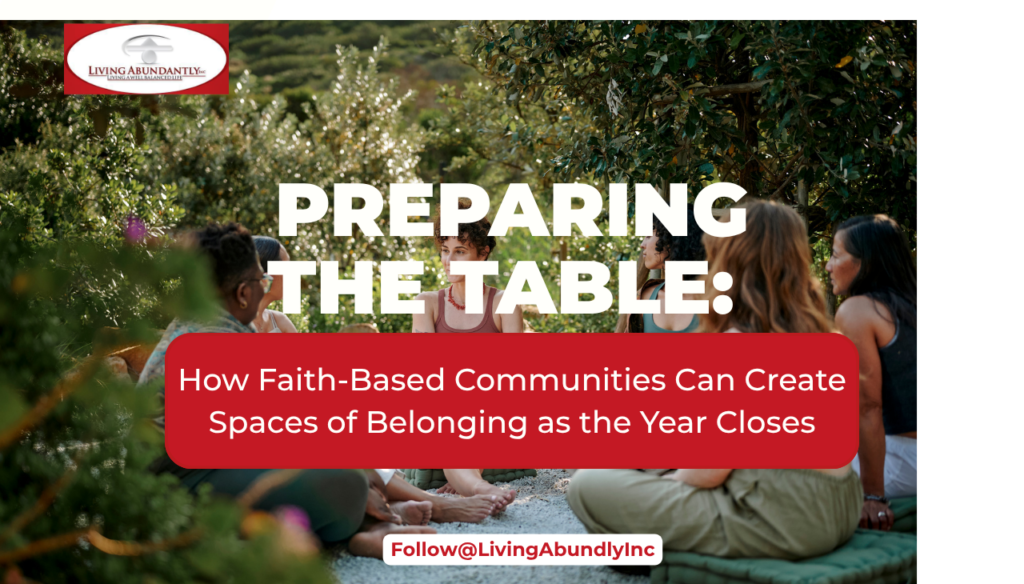
As the year moves toward its close, tables become important places.
Families gather. Churches host meals. Community organizations hold celebrations. Friends reconnect. People travel. Traditions return.
Yet for some, this season magnifies what is missing.
An empty seat. A fractured relationship. A recent move. The absence of family. A community they have not yet found. A season of loneliness hidden beneath public celebration.
This is why faith-based community belonging matters especially as the year closes.
A faith community has the opportunity to offer more than an event. It can create a place where people are noticed, welcomed, included, listened to, and invited into meaningful relationship.
Faith-Based Community Belonging Requires More Than an Open Door
A sign can say, “Everyone is welcome.”
That does not automatically mean everyone experiences belonging.
Welcome is an invitation. Belonging develops through relationship.
Someone learns your name. Someone notices when you are absent. Someone asks a second question after “How are you?” Someone creates room for your contribution. Someone follows up after you share a need. Someone helps you understand how to become part of the community rather than leaving you to navigate it alone.
“Hospitality opens the door. Belonging gives people a reason to believe there is room for them beyond the doorway.” |
Hebrews 10 describes community as active encouragement—people gathering and intentionally stirring one another toward love and good works. Read Hebrews 10:24–25 on Bible Gateway
Faith communities become transformative when gathering creates genuine connection rather than simply shared attendance.
The Table Is a Spiritual Picture of Inclusion
Tables appear throughout Scripture as places of provision, fellowship, reconciliation, teaching, remembrance, and community.
Preparing the table therefore becomes a powerful metaphor.
Who has a chair? Who is expected? Who has been forgotten? Who feels they need to perform before they are welcome? Who attends but remains unknown? Who has stopped coming? Whose voice rarely enters the conversation?
“A community reveals its values not only by who is invited to the table, but by whether people can arrive and know there is truly a place for them.” |
The purpose is not to create superficial inclusion.
Real belonging includes dignity. Accountability. Mutual responsibility. Healthy boundaries. Contribution.
People should not only receive from the community. As relationships mature, they should have opportunities to participate, serve, lead, encourage, and give.
That is how belonging becomes shared life.
Notice the People the Season Can Easily Overlook
The closing months of the year can be joyful. They can also intensify loneliness.
Consider: The older adult whose family lives far away. The young person who feels unseen at home. The single parent carrying the season alone. The newcomer with no established relationships. The recently bereaved family attending their first holiday season after a loss. The person experiencing financial pressure. The couple navigating conflict. The caregiver who serves everyone while rarely being cared for. The leader who is expected to remain strong.
CDC information on social connection notes that meaningful relationships support health, belonging, resilience, and our capacity to handle difficult circumstances. It also identifies community organizations and places of worship as environments that can strengthen social connection. Explore CDC guidance on strengthening social connection
Faith-based communities are uniquely positioned to notice.
But noticing requires intentionality.
People can attend a crowded event and still leave lonely.
Build Connection Before You Build Another Event
Communities often respond to seasonal needs by creating more programming.
Sometimes another event is useful. Sometimes what people actually need is deeper connection within what already exists.
Instead of asking only, “What can we host?” ask: Who needs follow-up? Who could be connected to a small group? Which family may need practical help? Who needs transportation? Who is new? Who could benefit from a mentor? Who has gifts but has never been invited to contribute? Which members could host someone who would otherwise spend the season alone?
This shifts community leadership from programming to relationship-building.
Living Abundantly’s Faith in Action reflects this principle by connecting spiritual conviction with practical community impact and purposeful service. Read Faith in Action
Community is not simply what happens in the room. It is what happens between people.
Families Can Help Expand the Table
Hospitality does not belong only to churches and organizations.
Families can participate.
Invite someone. Prepare an extra plate. Check on a neighbor. Include someone who recently moved into the area. Let children participate in welcoming guests. Support another family quietly. Share food without making the recipient feel like a project. Ask an older relative to tell family stories. Make space for intergenerational connection.
These practices teach children that home can be a place of ministry.
Living Abundantly’s The Abundant Family emphasizes the importance of spiritually and relationally healthy households capable of nurturing communication, character, purpose, and connection. Read The Abundant Family
A family table becomes abundant not simply because it contains more food.
It becomes abundant when it contains more love, attention, gratitude, dignity, and willingness to share.
Belonging Also Requires Listening
People do not feel known simply because we speak kindly to them. We must also listen.
Ask about their experience. Ask what would help them feel more connected. Listen to young people. Listen to older adults. Listen to newcomers. Listen across cultures. Listen to people whose life circumstances differ from your own.
Do not assume that one type of gathering, communication style, worship expression, or service opportunity works equally well for everyone.
Listening does not mean every preference becomes policy. It means leadership receives enough information to care intelligently.
Living Abundantly’s coaching and ministering services emphasize personalized support precisely because transformation is not one-size-fits-all. Its programs begin by hearing the person’s story, clarifying needs, and developing an appropriate support path.
The same principle strengthens community. Know people before assuming what they need.
Belonging Should Continue After the Calendar Changes
A Thanksgiving outreach can matter. A December meal can matter. A year-end service project can matter.
But belonging cannot become seasonal charity.
If we invite people in November and forget them in January, we created an event—not community.
The stronger question is: What relationship can continue?
Can a family be connected to ongoing support? Can a young adult join a mentoring relationship? Can an older member become connected to consistent companionship? Can volunteers continue serving together? Can the person who was helped eventually be invited to contribute?
This is where community becomes sustainable.
Living Abundantly’s From Surviving to Serving expresses this progression well: people who receive support can eventually transform their experience into service and lasting impact. Read From Surviving to Serving
The goal is not permanent dependency.
It is relationship, development, and mutual contribution.
Seven Ways to Prepare the Table for Belonging
1. Identify who may be missing. Consider newcomers, isolated individuals, grieving families, older adults, young people, single parents, and others who may need intentional connection.
2. Assign people, not just tasks. At gatherings, give trusted volunteers responsibility for welcoming, introducing, listening, and following up.
3. Create smaller spaces within larger events. Conversation becomes easier when people can connect in manageable groups.
4. Invite contribution. Ask people to bring a dish, share a story, help serve, lead prayer, participate in music, or offer another meaningful contribution.
5. Follow up after the gathering. Connection should not end when chairs are folded.
6. Create pathways into ongoing community. Offer small groups, mentoring, service opportunities, family connections, coaching, or other ways to remain engaged.
7. Evaluate belonging, not just attendance. Do not measure success only by how many people came. Ask whether people felt seen, respected, connected, and invited into continued relationship.
REFLECTION BOX • Who in my community may experience this season more as loneliness than celebration? • Does our community create belonging or mainly host events? • Who attends regularly but may still feel unseen? • Where can my family create room for someone else? • What relationship should continue after the holiday season ends? |
Prepare More Than the Table
As this November series closes, thanksgiving, seasons, and belonging come together.
We thank God for faithfulness. We learn to trust Him across changing climates. Then we allow that faith to change the way we make room for people.
Living Abundantly Vision’s mission is rooted in helping people grow through faith-based, personalized, holistic support that strengthens relationships and promotes meaningful transformation.
As the year closes, prepare the meal. Prepare the room. Prepare the program. But also prepare your heart to notice who needs a chair.
Because sometimes the most abundant thing we can offer is not what sits on the table.
It is the message communicated by the empty place we intentionally prepared: You were expected. You matter. There is room for you here.
“The table becomes sacred when people do not simply receive an invitation—they experience the dignity of knowing they truly belong.” |
HELP CREATE SPACES WHERE PEOPLE CAN GROW
Explore faith-rooted support for spiritual development, personal healing, relationships, and abundant living.
Explore Living Abundantly Programs & Pricing
Keep Reading: The Abundant Family